Best app to learn to speak Swedish in 2026: pronunciation and conversation
Short answer
Our pick is SFI Prov. You listen and repeat, answer questions in everyday situations, get pronunciation analysis word by word and can talk with AI. All of it is free. We make the app ourselves. For talking with real people, language exchange apps such as HelloTalk and Tandem, or a language café, are a good fit.
Speaking Swedish takes two things: a pronunciation other people understand, and the courage to speak. Apps can help you with both, but the second one needs people in the end. Here we show what is hardest about Swedish pronunciation, which apps train pronunciation and conversation, and where you can talk with people for free. We make one of the apps ourselves, SFI Prov, so we say that up front.
Our pick is SFI Prov: you listen and repeat, answer questions, get your pronunciation analysed word by word and can talk with AI, and all of it is free. If you want to read more about conversations with AI, we have a separate guide to the best AI apps to learn Swedish.
What is hardest about Swedish pronunciation?
- Long and short vowels. Glas with a long a is a glass you drink from; glass with a short a is ice cream. Two consonants after a vowel usually mean it is short.
- The sj-sound. It is spelled in several ways: sju (seven), skjorta (shirt), stjärna (star) and sked (spoon) all start with the same sound.
- The melody. Two words can be spelled the same and sound different. Tomten (the garden) and tomten (the Christmas figure) are told apart only by their melody.
- The stress. Many Swedish words are stressed on the first syllable, but words starting with be- and för- and many loanwords are stressed later, such as betala (pay), förstå (understand) and restaurang (restaurant).
There is more about the sounds and letters in Learn Swedish from zero.
Quick overview
| App | Trains | Free |
|---|---|---|
| SFI Prov | Pronunciation, repetition and conversation | Yes |
| Pimsleur | Listening and answering aloud | A trial lesson |
| HelloTalk and Tandem | Conversation with people | Yes, with paid extras |
| italki and Preply | Lessons with a teacher | No, per lesson |
| Forvo | Pronunciation of single words | Yes |
The apps
SFI Prov (our app and our pick)
SFI Prov is made by SverigeFokus, which also publishes this blog. The app takes you from zero to the SFI test, and you train speaking in several ways:
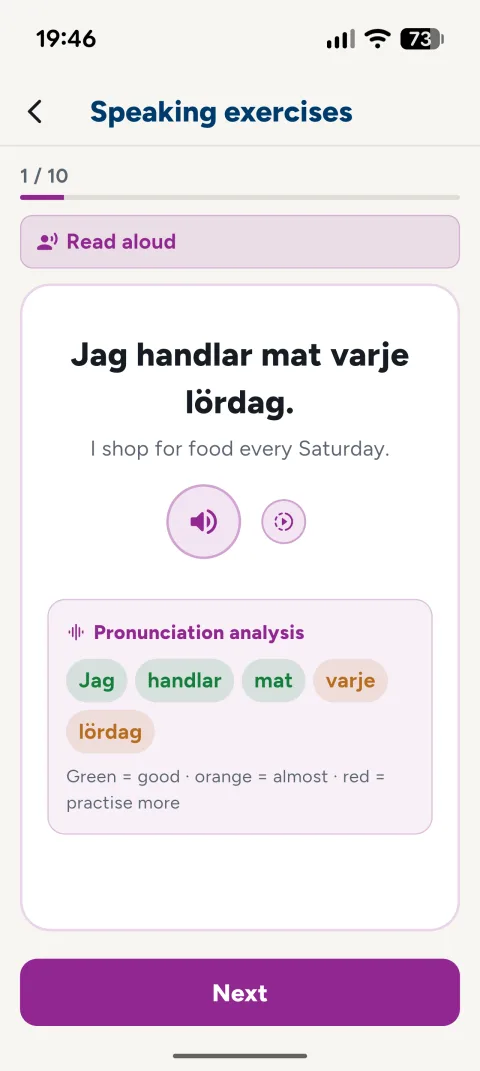
- Speaking exercises. In Repeat to learn you listen to a sentence and say it after, and in Conversational you answer questions in everyday situations. The app listens with your phone’s speech recognition and shows whether it understood you.
- Pronunciation analysis. You read a sentence aloud, and the app shows word by word, in colour, which words you pronounced well and which need more practice.
- Sentence of the week. Every week there is a new sentence to say, with pronunciation analysis.
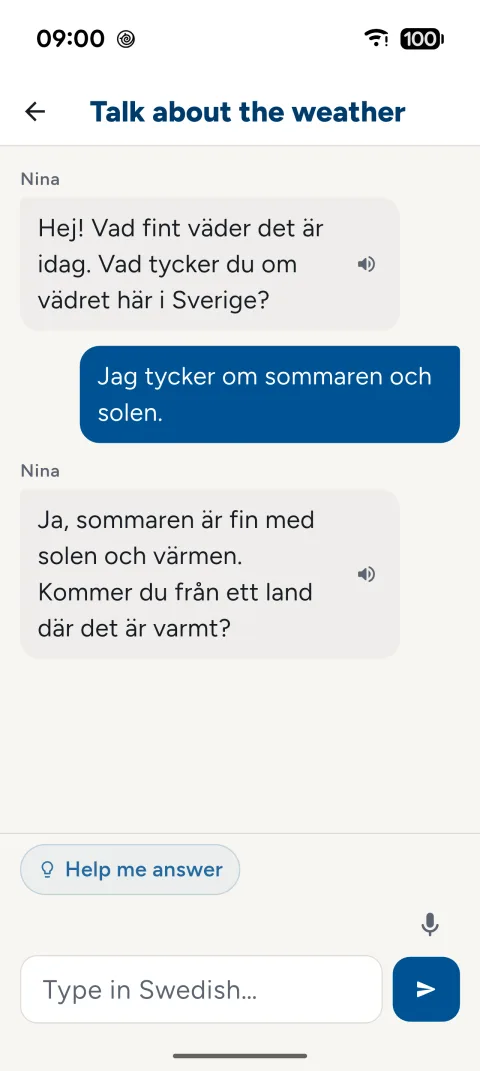
- Talk with AI. In Free-talk you talk with AI characters in everyday situations, and afterwards you can practise pronouncing the sentences you said.
- In the lessons and tests. The beginner course has speaking exercises in its lessons, and the practice tests have a speaking part.
Good to know: the app uses your phone’s speech recognition. If it does not hear you, you may need to add Swedish for speech recognition or dictation in your phone’s settings. The pronunciation analysis assesses the words but not the melody, so listen and imitate to learn the melody. What does it cost? Nothing. The app is free, with no ads and no subscription. The pronunciation analysis and the conversations with AI need a free account and an internet connection. Download: App Store and Google Play.
Pimsleur
Pimsleur is an audio course in Swedish: you listen, repeat and answer aloud, without having to look at the screen.
Good for: getting used to answering quickly, for example while you walk or cook. Less good for: reading and writing, which the SFI test also assesses. Price: it costs money. You can try a lesson for free.
HelloTalk and Tandem
In language exchange apps you write and talk with Swedish speakers who want to learn your language. You help them, and they help you.
Good for: talking with real people once you know the basics. Less good for: complete beginners, since nobody teaches you from the start. Price: free, with paid extras.
italki and Preply
Here you book video lessons with a Swedish teacher.
Good for: getting a teacher who corrects your pronunciation and adapts the conversation to you. Less good for: a small budget. Price: you pay per lesson, and the price varies between teachers. Many offer a trial lesson.
Forvo
Forvo is a free pronunciation dictionary where people who speak the language record words.
Good for: hearing how a single word sounds, often said by several people. Less good for: whole sentences. The recordings are made by users, so not every pronunciation is standard. Price: free.
Where can you speak Swedish for free?
- Language cafés. Many libraries run free conversation groups, where everyone is there to practise.
- Your classmates at SFI. Speak Swedish with each other during breaks, even if you share another language.
- Everyday life. Say one sentence a day in Swedish, in a shop, at the pharmacy or to a neighbour.
How can shadowing improve your pronunciation?
- Choose a short recording, for example a news story from Radio Sweden på lätt svenska (news in easy Swedish).
- Listen to one sentence and pause.
- Say the sentence aloud with the same melody and at the same pace.
- Record yourself and compare with the original.
- Repeat until it sounds the same, then move on to the next sentence.
Five minutes a day is a good start. What matters is that you do it often.
Summary
- Best app to learn to speak Swedish: SFI Prov, with speaking exercises, pronunciation analysis, the sentence of the week and conversations with AI. Free.
- For answering aloud without a screen: Pimsleur.
- For talking with people: HelloTalk and Tandem, and language cafés.
- For lessons with a teacher: italki and Preply.
- For hearing single words: Forvo.
Sources
- Isof: the Swedish tonal accents (in Swedish)
- Pimsleur: Swedish
- HelloTalk and Tandem
- italki: Swedish teachers
- Preply: Swedish tutors
- Forvo: Swedish
- Sveriges Radio: Radio Sweden på lätt svenska
- Stockholm City Library: language café
SFI Prov is independent practice material from SverigeFokus and is not affiliated with Skolverket, your municipality or any other authority.
The app for SFI and Swedish
Frequently asked questions
What is the best app to learn to speak Swedish?
Our pick is SFI Prov. You listen and repeat, answer questions in everyday situations, get pronunciation analysis word by word and can talk with AI. All of it is free. We make the app ourselves. For talking with real people, language exchange apps such as HelloTalk and Tandem, or a language café, are a good fit.
How do I improve my Swedish pronunciation?
Listen to real voices, ideally at a slow speed, and imitate them aloud. Record yourself and compare. Practise long and short vowels, the sj-sound and the melody in particular, and get feedback word by word, for example with the pronunciation analysis in SFI Prov.
Is there an app that corrects my pronunciation?
Yes. In SFI Prov you read a sentence aloud, and the app shows word by word, in colour, which words you pronounced well and which need more practice. It assesses the words but not the melody of Swedish, which you learn best by listening and imitating.
Where can I speak Swedish for free?
At language cafés, which many libraries run, with your classmates at SFI, in language exchange apps such as HelloTalk and Tandem, and with AI in apps such as SFI Prov.
What is hardest about Swedish pronunciation?
Many learners find vowel length, the sj-sound and the melody the hardest. Glas with a long a and glass with a short a mean different things, the sj-sound is spelled in several ways, and only the melody separates tomten, the garden, from tomten, the Christmas figure.
How do I dare to speak Swedish?
Start where it feels safe: talk to an app or an AI where nobody hears you, then go to a language café where everyone is there to practise. Decide to say one sentence a day to someone, in a shop or at work.